#endpoint-forensics #volatility2 #powershell #shimcache #strings #cyberdefender-medium #reviewed #finished
Scenario
A SOC analyst took a memory dump from a machine infected with a meterpreter malware. As a Digital Forensicator, your job is to analyze the dump, extract the available indicators of compromise (IOCs) and answer the provided questions.
Questions
Q1 — SHA1 Hash of Dump
What is the SHA1 hash of Triage-Memory.mem (memory dump)?
We use Get-FileHash in PowerShell on Windows to get the hash of the memory dump.
Similarly, on Linux we can use sha1sum.
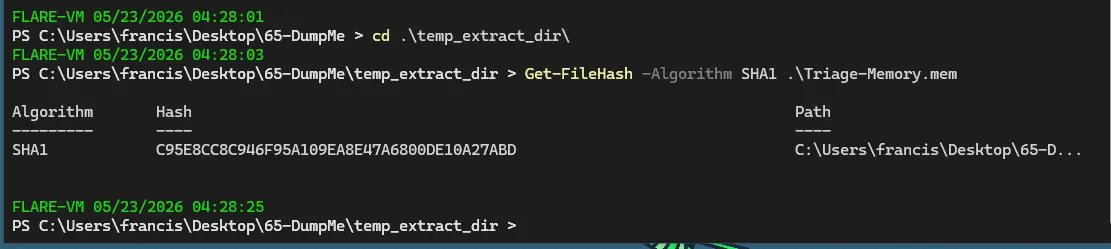
Answer: C95E8CC8C946F95A109EA8E47A6800DE10A27ABD
Q2 — Volatility Profile Selection
What volatility profile is the most appropriate for this machine? (ex: Win10x86_14393)
In volatility2, we need a profile, otherwise it will not be able to properly map memory locations.
We get suggested profiles using imageinfo.
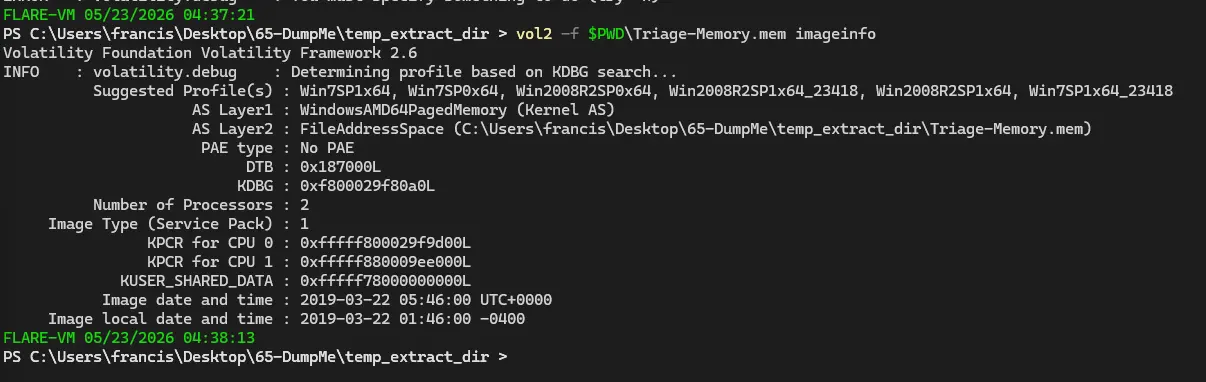
Answer: Win7SP1x64
Q3 — Process ID of Notepad
What was the process ID of notepad.exe?
We use the vol2 plugin pslist to list all the processes at the time of image capture and do a sls, the cmdlet for select-strings, for notepad.
This gets us the PID of notepad, which is 3032.

Answer: 3032
Q4 — Child Process of Wscript
Name the child process of wscript.exe.
For this we use the plugin pstree, which shows the parent processes and their subsequent child processes.
We then do a sls for wscript with a context window of 0,10 which means include 10 lines after the match and 0 lines before the match.
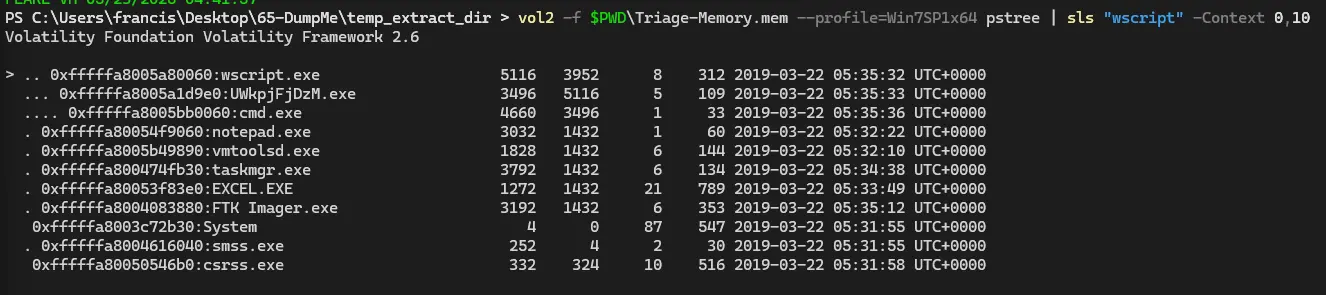
Answer: UWkpjFjDzM.exe
Q5 — IP Address of Machine
What was the IP address of the machine at the time the RAM dump was created?
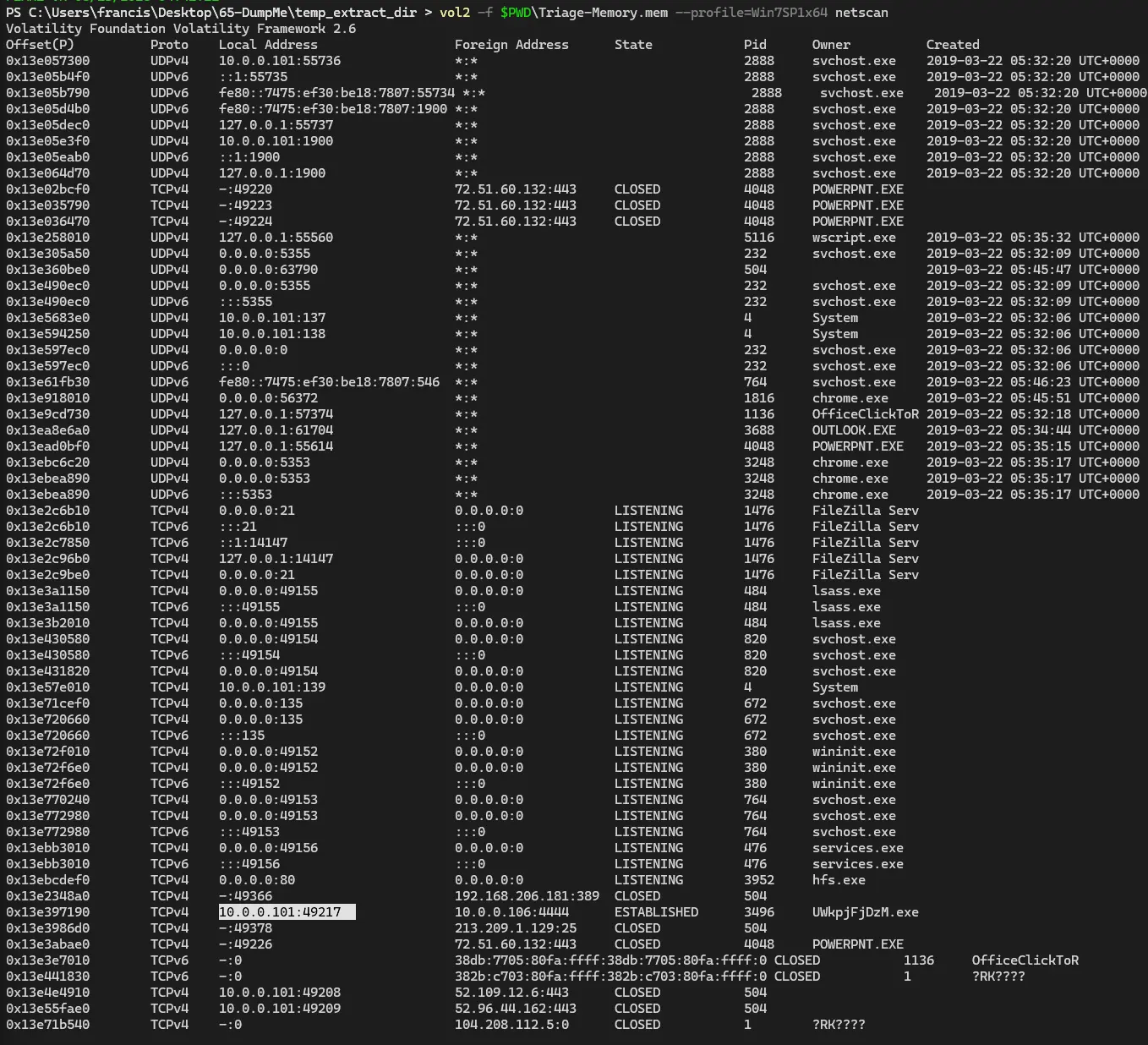
For this we use netscan, which shows the network connections established at the time the RAM dump was created.
We can see the local IPv4 address is 10.0.0.101.
Answer: 10.0.0.101
Q6 — Attacker IP Address
Based on the answer regarding the infected PID, can you determine the IP of the attacker?
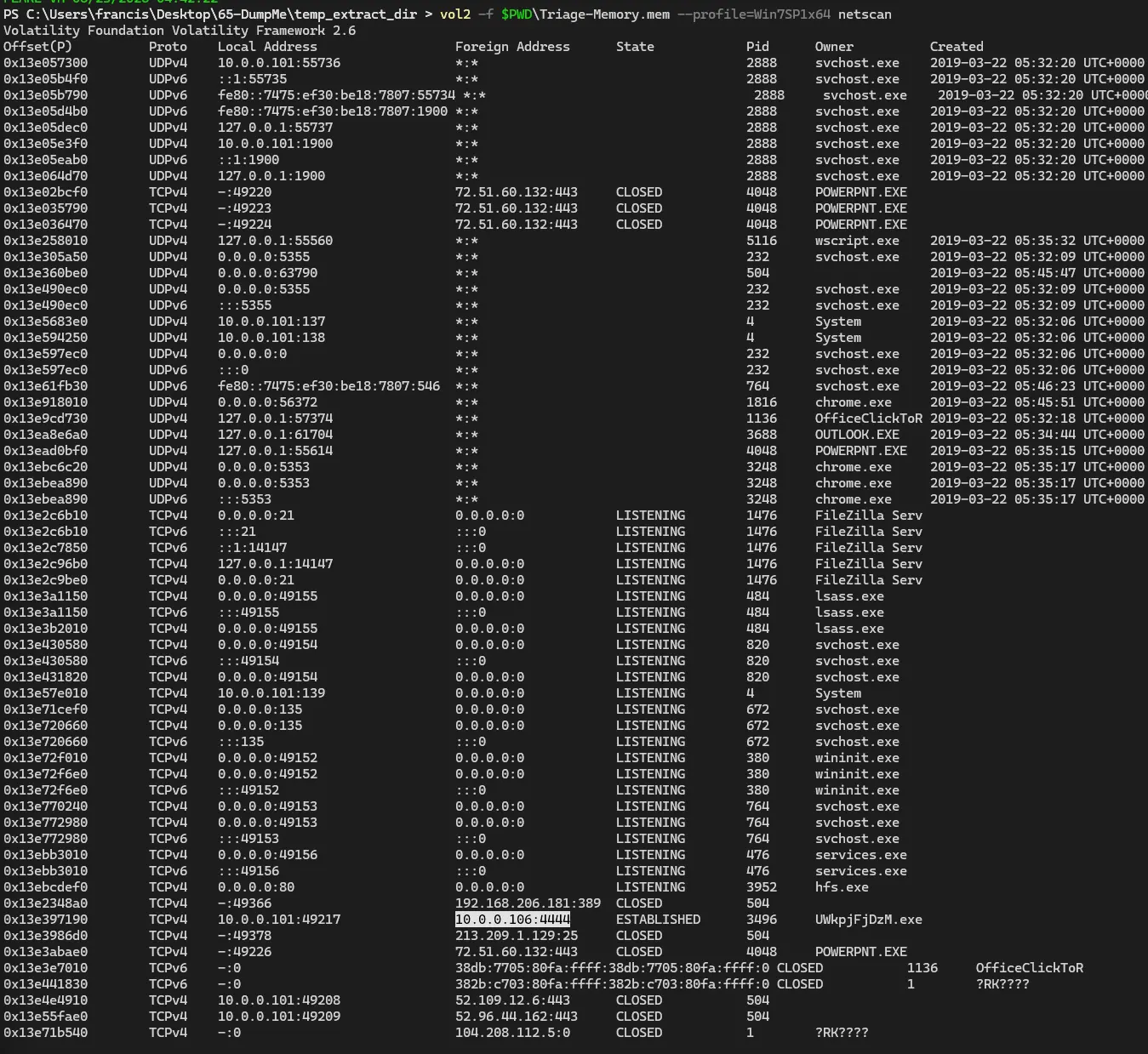
We know the infected PID is 3496, so we can find the IP of the attacker by checking if that process has established any network connections.
We can see this in the netscan output where PID 3496 has an established connection to 10.0.0.106.
Answer: 10.0.0.106
Q7 — Number of Associated Processes
How many processes are associated with VCRUNTIME140.dll?
For this we use the dlllist plugin and sls for vcruntime140.
This shows us how many processes are handling VCRUNTIME140.dll.

Note: The command is actually correct, but only returns 1 process in my case. I checked the sha1sum in question 1 and it matches, so the memory dump is not corrupted. I am not sure why my output differs from the actual answer, but the command used here is correct.
Answer: 5
Q8 — MD5 of Infected Process
After dumping the infected process, what is its md5 hash?
We first dump the process with PID 3496 using procdump.

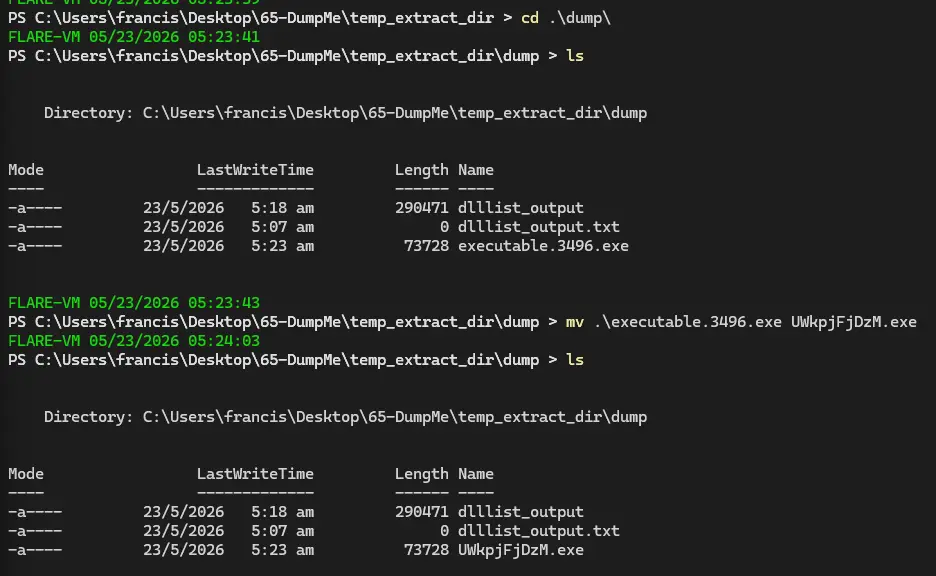
We then use Get-FileHash to get the MD5 hash of the malicious process.

Answer: 690ea20bc3bdfb328e23005d9a80c290
Q9 — LM Hash of Bob’s Account
What is the LM hash of Bob’s account?
This is trivially solved using the hashdump plugin, where the LM hash of Bob’s account is the first hash (left to right) in his entry.

Answer: aad3b435b51404eeaad3b435b51404ee
Q10 — Memory Protection Constants of VAD Node
What memory protection constants does the VAD node at 0xfffffa800577ba10 have?
We use the vadinfo plugin for this and sls the memory location in the question to find the one we want.

Answer: PAGE_READONLY
Q11 — Memory Protection of VAD Range
What memory protection did the VAD starting at 0x00000000033c0000 and ending at 0x00000000033dffff have?
Similarly, we use vadinfo again, but this time sls has two positive lookaheads. This causes the command to return matches that contain both values simultaneously.

Answer: PAGE_NOACCESS
Q12 — Name of VBS Script
There was a VBS script that ran on the machine. What is the name of the script? (submit without file extension)
We use cmdline here because it scans how programs were invoked and what arguments were passed to them.
If a VBS script ran, it means wscript must have been invoked with the file as the argument.
Therefore, we can see the name of the script by looking through cmdline.

Answer: vhjReUDEuumrX
Q13 — Application Run at Specific Timestamp
An application was run at 2019-03-07 23:06:58 UTC. What is the name of the program? (Include extension)
shimcache is a plugin that allows us to track which executable files have been run or were present on the system.
It works by extracting the Application Compatibility Cache from a Windows memory image.
We can then sls for that timestamp to find what program was last modified at that time.

Answer: Skype.exe
Q14 — Notepad Content at Time of Dump
What was written in notepad.exe at the time when the memory dump was captured?
To figure this out we can dump the entire addressable memory of the notepad process using memdump.

We can then rename the dump to notepad_memdump, then perform strings on it.
We will send the strings output into a text file, so it is easier to analyse.
It should also be noted that -u is passed to strings because Windows uses little endian.
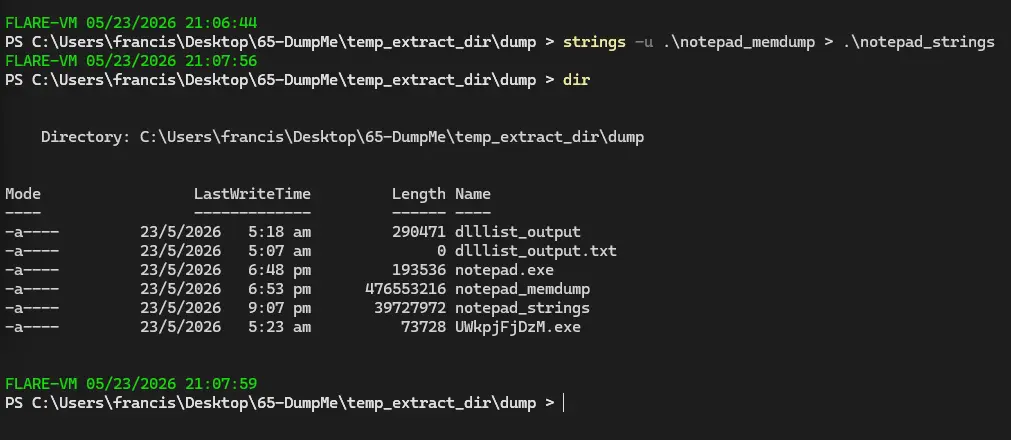
We can create a regex pattern based on the CyberDefenders censored placeholder.


Though this is a pretty cheesy way of doing it, a more proper way is just to grep for some key terms like flag or a regex pattern like .+\<.+>.
Also a small note, we do not need to actually escape < or > here.
Answer: flag<REDBULL_IS_LIFE>
Q15 — Short Name of File Record 59045
What is the short name of the file at file record 59045?
To get the short name of a file we need to check the MFT which is the master file table.
To see the MFT we need to use mftparser.
Then we just sls for file record 59045.

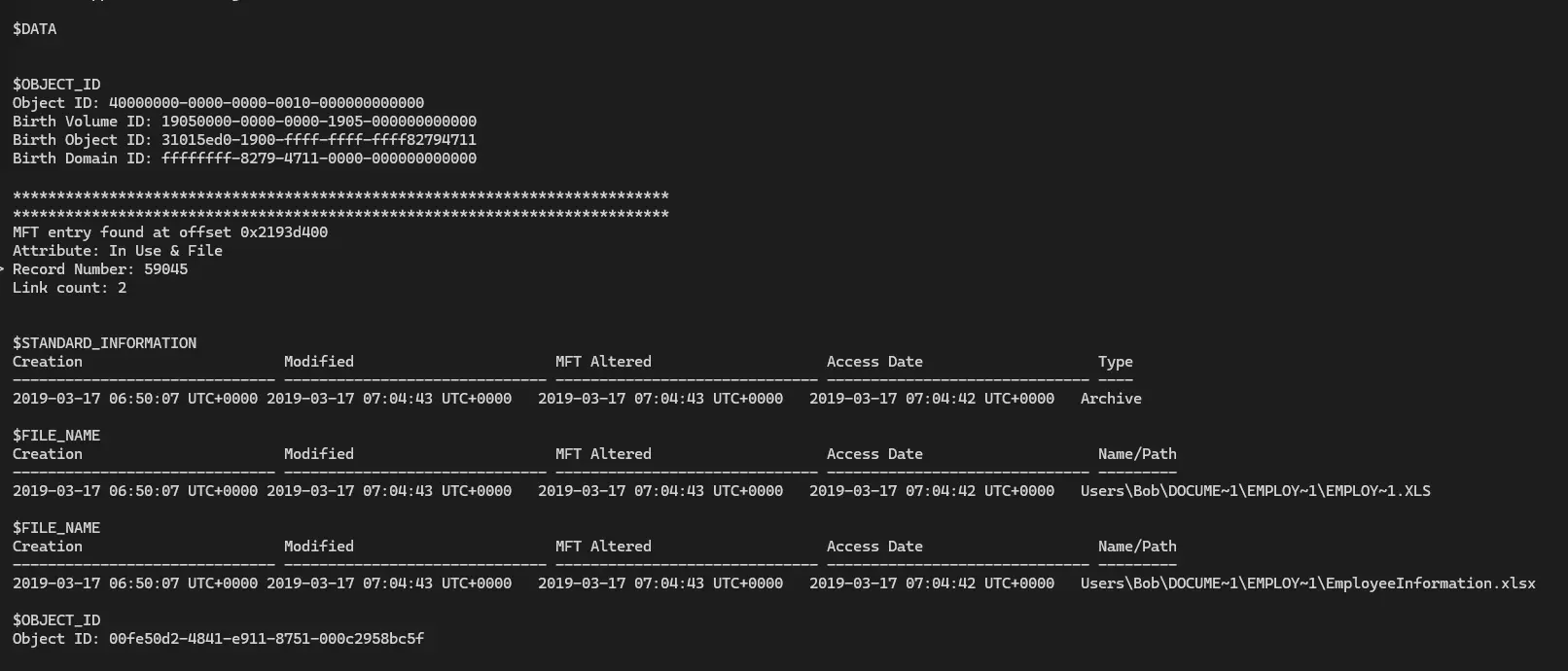
Answer: EMPLOY~1.XLS
Q16 — Infected PID (Meterpreter)
This box was exploited and is running meterpreter. What was the infected PID?
Meterpreter is a payload in Metasploit that functions as a RAT. We can check netscan to see if there are any services that connect on the default Metasploit port (4444).


The PID is 3496, which corresponds to the infected process we found earlier.
Answer: 3496
Completion